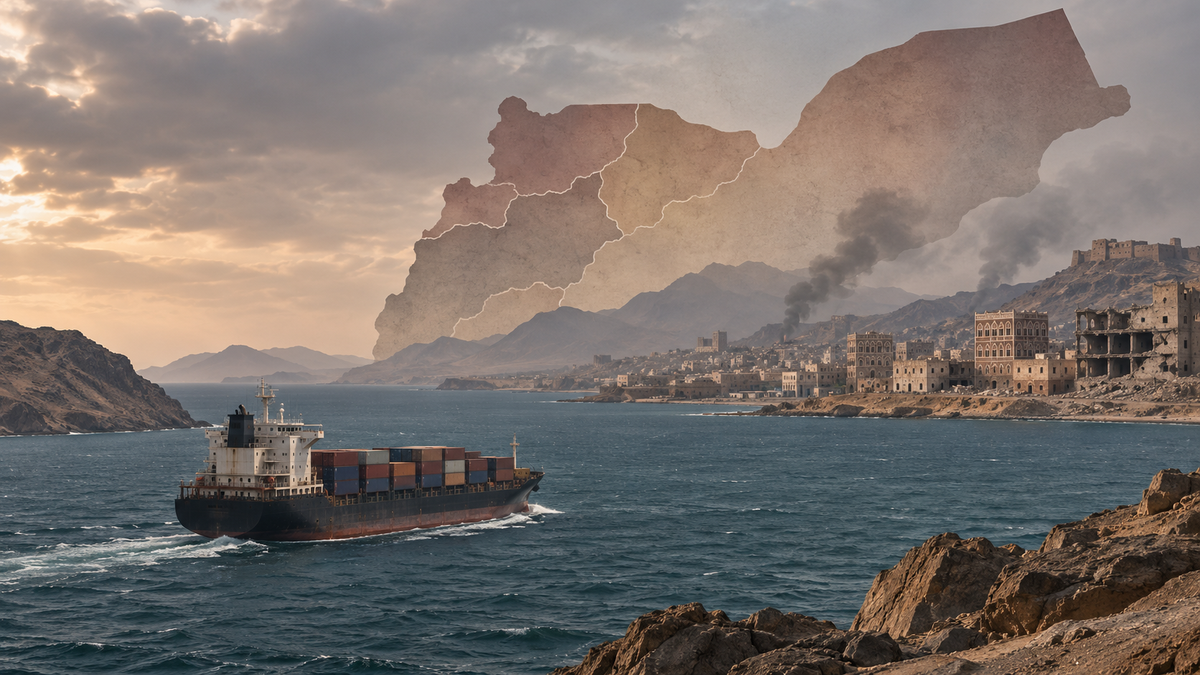
For years, Yemen appeared in international headlines chiefly as a humanitarian catastrophe: malnourished children, displaced families and a society devastated by war. Images of suffering often eclipsed the country’s complex political struggles. Then attacks on Red Sea shipping from late 2023, followed by a dramatic escalation in 2026, returned Yemen to global attention—this time as a threat to a vital trade route. Yet another calamitous threat to the already-exposed international order grounded in law and commerce.
This shift raises an important question: why does Yemen become a strategic concern when shipping is threatened, while the underlying conflict that makes these waters unsafe remains unresolved?
The answer lies on land, rather than at sea.
A Coup and an Unfinished War
Yemen's war is often described as a confrontation between Saudi Arabia and the Houthis. While this reflects one aspect of the conflict, it overlooks the deeper struggle over legitimate authority within Yemen.
The Houthis, who call themselves Ansar Allah, are an armed political movement led by Abdulmalik al-Houthi. They emerged from Zaydi religious revivalist networks in the northern governorate of Saada during the 1990s. They later developed into a full-fledged insurgency, engaging in six wars against the Yemeni state between 2004 and 2010. While its origins are rooted in religion, the movement's leadership has established a highly centralised, family-dominated structure that claims political authority based on descent from the Prophet Muhammad. Houthis' ideology should not be confused with the beliefs of Yemen's broader Zaydi community. Currently, the movement holds de facto control over Sana'a and much of northern Yemen, receiving increasing military support from Iran in its informal war against Trump’s America.
The 2011 Yemeni revolution, which was part of the Arab Spring, initiated a political transition that culminated in the National Dialogue Conference in early 2014. Although imperfect, this process offered a negotiated approach to establishing a new political order. In September 2014, the Houthis, along with forces loyal to former President Ali Abdullah Saleh, took control of Sana'a. Their actions to remove the transitional authorities. This was, de facto, a coup against this hopeful yet imperfect process and the state institutions beginning to take shape.
In March 2015, Saudi Arabia led a coalition in an armed intervention at President Abdrabbuh Mansur Hadi's request. With the coalition's support, anti-Houthi Yemeni forces regained control of Aden and much of the southern region, while also advancing toward Hodeidah in 2018. Concerns that an assault on this critical port would disrupt food and fuel supplies and have serious humanitarian consequences led to the UN-brokered Stockholm Agreement, which ultimately halted the offensive.
Although the ground situation was dire and humanitarian concerns were valid, analysts continue to debate whether halting the offensive allowed the Houthis to redeploy forces elsewhere and take a necessary pause that ultimately saved them from defeat. The Stockholm Agreement showcased a significant dilemma: while it may have averted an immediate catastrophe, it did not resolve the ongoing struggle for armed power and state authority. In the years since, the Houthis have grown stronger both militarily and politically.
When External Patronage Fragments the State
The anti-Houthi camp, on the other hand, never consolidated into a unified political and military command. Instead, regional sponsorship helped create rival centers of power.
While Saudi Arabia backed the internationally recognised government, the United Arab Emirates financed and equipped players operating with varying degrees of independence from its command. These included the separatist Southern Transitional Council (STC) and Tariq Saleh’s National Resistance on the western coast. Their political agendas were not identical, but both reflected a system in which outside sponsorship created military/political structures that exercise enough influence to make a unified state structure difficult to imagine any time soon.
That contradiction became visible in December 2025, when the UAE-backed STC pushed into Hadramawt and al-Mahra, and confronted Saudi-backed actors. Tariq Saleh publicly endorsed the STC’s advance, despite the tensions it caused within the anti-Houthi coalition. Saudi-backed forces subsequently reversed much of the STC’s territorial expansion in January 2026.
The result was more than a quarrel among allies. Forces ostensibly united against the Houthis were divided by competing projects, petty interests, and loyalties to different regional actors. The fragmentation weakened the prospect of a coherent response as the war intensified.
Mokha and Taiz: What Weapons Cannot Explain
In September 2026, Houthi forces captured Mokha, a strategic port near Bab al-Mandeb, after the withdrawal of Tariq Saleh’s National Resistance forces. An Associated Press investigation described fractured communications, confusion over retreat orders and military equipment left behind.
The description of such a shambolic operation raises questions about the solidity of military/political formations that have received enormous external support yet have shown little effectiveness of their own.
Taiz offers a striking contrast. Encircled by the Houthis amid a worsening humanitarian crisis, government troops and local volunteers have continued defending the city. Reporting from the front describes fighters lacking sufficient heavy weapons and relying on local networks to obtain basic supplies and ammunition. Their defense cannot be understood through equipment totals alone. For many, the fight is about protecting their homes, families, and city.
That contrast makes motivation and cohesion relevant questions. External funding can build units and supply necessary gear; it cannot, by itself, create a shared political purpose or durable trust between fighters and commanders. But it would be simplistic to attribute Mokha’s fall solely to weak morale, or Taiz’s defense solely to conviction. Terrain, tactics, leadership and Iranian support for the Houthi offensive also matter.
The broader point is that fragmentation and externally shaped chains of command carry costs that become most visible under pressure.
Whose Security Is Being Secured?
The Red Sea is not merely a global shipping corridor; it is also part of Yemen's geography and economy, and key to any serious understanding of its future. Protecting vessels is mandatory. It does not, though, resolve Yemen's governance issues, including who holds a monopoly on violence and whose political voice is heard.
A postcolonial analysis of the war reveals a contradiction: international and regional powers claim to defend Yemen's sovereignty while, at times, supporting armed groups that compete with state institutions representing the nation. Meanwhile, Yemenis are often portrayed either as perennial victims or as residents of a crucial geopolitical area of which everybody has an opinion, rather than as active participants in shaping their own country's future.
Accountability must extend to Yemeni actors too, including the Houthis' role in cancelling a political transition and the abuses committed by parties across the conflict. A durable settlement cannot rest solely on deals among external patrons and warlords. It must address the legitimacy of public institutions, the responsibility and future role of armed groups, and how to foster, once and for all, meaningful political participation by the Yemeni population.
The conflict in Yemen did not originate with the attacks on international ships, and it will not conclude merely with their return to safe passage. To achieve enduring security in the Red Sea, a meaningful political resolution on land is essential.
Mousa Alansary is a Yemeni political researcher and analyst focusing on Yemen’s conflict, regional politics, and humanitarian governance. He is the Co-founder and Director of Strategic Relations at Raydan Forum.