To think about democracy as a political phenomenon in any country is already an immense challenge. To think about it in a country such as Brazil, with its continental dimensions and its ethnic, social, religious, and political diversity, makes the task of understanding its political context all the more urgent and demanding.
The title of this essay draws inspiration from the study by Levitsky and Ziblatt (2018), but approaches the question through Brazil’s 2026 presidential election, contested by Luiz Inácio Lula da Silva and Flávio Bolsonaro. Before attempting to delve into this complex subject and discuss it with a measure of boldness, however, I offer an invitation: let us look to the past before examining the present and trying to imagine the future.
Democratic political experience in Brazil emerged as a movement in opposition to the Brazilian monarchy. The military coup of 1889, which overthrew Emperor Dom Pedro II and established the Republic, did not fundamentally change the political chessboard: it merely rearranged the pieces.
This political model endured, marked by restrictions on electoral participation, including requirements concerning age, gender, and economic standing, as well as indirect mechanisms of political selection. Its limitations accompanied the First Republic until the rupture of 1930, led by Getúlio Vargas. Brazil’s incipient democratic experience would then be interrupted by a new authoritarian cycle, culminating in the Estado Novo and ending in 1945.
History, however, does not stand still. And I ask you, the reader, not to lose sight of the passage of time. If we began this conversation in 2026, why have we returned to the beginning of the twentieth century? My answer is simple: so that we may retain some sense of the continuity—or fragility—of Brazil’s democratic experience. If we agree that democracy is not simply the act of voting, but also requires freedom, the rule of law, equality, universal suffrage, a free press, and political parties with some degree of organic representation in society, perhaps we have found common ground and can move forward.
If we accept these minimum criteria, we will probably agree that Brazil’s political experience in the early twentieth century can hardly be described as fully democratic. In the First Republic (1889-1930) and, in a different way, under the Estado Novo (1930-1945), we find experiences of republican state organization and highly restricted forms of democratic participation—or its outright suppression. These processes occupied decades of our republican history, which will reach its 137th anniversary on November 15, 2026.
We should not, however, abandon our conversation about the 2026 election, even if it seems that the author is straying from the subject. Let us return to 1945: with the end of the Second World War, Getúlio Vargas’s government also came to an end. But Brazil is not a single, uniform country. To the surprise of some, the political leader, with his strong nationalism and pronounced populist appeal, won the 1950 election with approximately 48 percent of the vote and remained in office until 1954, when he took his own life—a story we may leave for another occasion.
Between 1954 and 1964, Brazil experienced forms of democracy that, in a certain sense, we might understand as tutelary or delegative, drawing, with the necessary distinctions, on the reflections of Adam Przeworski and Guillermo O’Donnell. These were relatively broad and free political processes, but they were conditioned by the ever-present possibility of intervention by the Armed Forces. Thus, poised between the blade and its cutting edge, Brazil’s democratic experience continued until 1964, when another military coup overthrew João Goulart’s government.
We had resumed democratic life in 1945 and, by 1964, were once again forced to interrupt it through another military coup. Consider this: there were fewer than two decades in which to attempt to think democratically, within a generation marked by successive ruptures. Where have we left our calculator of democratic experience? If, between 1889 and 1945, we had a political experience of extremely low democratic intensity, punctuated by authoritarian regimes, we must acknowledge that the period from 1945 to 1964 was perhaps, with analytical generosity and according to the criteria we have agreed upon, the first more substantial national democratic experience, even though it too remained limited and vulnerable.
If we consider our young Republic, which will turn 137 in 2026, we see that by 1964 it had experienced something approaching competitive democracy for only a relatively brief period. The metaphor is that of a democracy that had barely come of age before having to wait another 21 years. In 1964, Brazil, like several Latin American countries at different moments, entered a dark period marked by coups d’état and authoritarian regimes.
In Brazil, the presidential election returned in 1985, still indirectly, inaugurating a new stage in the democratic experience, though not without upheaval. When I speak of modern democracy, I do not necessarily mean its quality, but the presence of political parties, expanded suffrage, freedom of the press, and the rule of law: basic ingredients for building a democratic experience. Nothing, however, is so simple. The first president elected by direct popular vote since 1960, Fernando Collor de Mello, came to power in 1989 and was impeached in 1992 amid allegations of corruption.
Between 1989 and 2016, Brazil underwent a democratic experience that, despite its upheavals, may be considered successful in important respects. In 2016, however, President Dilma Rousseff suffered what I interpret as a constitutional coup. We could use other terms, such as impeachment, but in my reading the political fact cannot be concealed behind words. In this context, Brazilian democracy witnessed an intensification of political radicalization and polarization, which would reach a decisive point with Jair Bolsonaro’s election in 2018.
The reader may ask why we have taken so long to reach the issue that concerns us on this October 26, 2026, one day after the presidential election in which, according to the scenario examined here, Luiz Inácio Lula da Silva defeated Jair Bolsonaro’s son. The answer is, once again, an invitation to look at Brazil’s democratic experience. Between 1989 and 2026, the population participated in the longest sequence of direct presidential elections in its republican history. That young democracy interrupted in 1964 is now an experience shaped by decades of learning, conflict, and contestation. It is with this trajectory that we must engage if we are to try to understand the present.
This young Republic and its even younger democratic experience have developed in a country of continental dimensions: its territory could accommodate approximately 35 areas the size of the United Kingdom, and its population is about three times as large. This comparison helps convey the scale of the challenge.
The 2026 election brings with it the many Brazils: their inequalities, peculiarities, and complexities. There is a heavily urbanized and industrialized South and Southeast; a Center-West characterized by commodity production; a Northeast still confronting the lasting consequences of XVII and XVIII centuries' colonial exploitation; and an Amazonian North with low population density, where the state’s presence is frequently insufficient to guarantee basic rights.
We cannot understand Brazilian elections without considering the path we have followed to reach this point. We are dealing with a relatively young democratic process, traversed by ruptures, and with a country marked by profound political, economic, and social inequalities.
In contemporary politics, Brazil is a product of its time: no more and no less than any other society, although it has characteristics of its own. This distinctiveness becomes less singular when we look out upon the world and observe, in other national contexts, the rise of political radicalism, the advance of far-right agendas, and populist discourses that seek to weaken the most basic institutions of democracy.
We must therefore return to 2018, when Jair Bolsonaro, after 28 years as a federal deputy, became president of the Republic with a binary political discourse in which there is an “us,” identified with the nation, and an “other,” transformed into an enemy. What conditions make the emergence of a disruptive political leader possible? To answer, I offer another invitation: let us consider Brazil as a national political project that has yet to find common ground, whether because of regional particularities or inequalities among its social groups.
Resentment and frustration in a society as complex as Brazil’s provide fertile ground for the discourse of political hatred, the construction of an enemy, and the idea that the other should have no rights. As a slogan associated with Jair Bolsonaro’s campaign suggested, “human rights for righteous humans”: a formula implying that some human beings do not deserve to be treated as such.
It is not exclusively Jair Bolsonaro, nor Flávio Bolsonaro, on whom we should dwell. The challenge is to understand why this political discourse resonates with segments of the population. Perhaps that task is too large for the present moment. Even so, it is worth examining the meaning of the Brazilian election more carefully.
Once again, Brazil revealed itself to be marked by inequalities, which also run through the life story of Luiz Inácio Lula da Silva: a metalworker from a family of migrants from the Northeast who settled in São Paulo, a trade unionist, and a man imprisoned during the military dictatorship. Lula has been a presence in Brazilian presidential contests since 1989, associated with a social and economic agenda that seeks to offer alternatives to economic liberalization and confront persistent inequalities.
On the other hand, we find a political, legal, and economic establishment that, since 2002, the year of Lula’s first election, has at different moments sought to weaken Brazil’s political and institutional process. We might suggest that something of what Aníbal Quijano called the coloniality of power persists among sections of the economic and political elites. When we examine the country’s economic, social, legal, and political structures, we identify not only the persistence but also the recreation of mechanisms of domination, hierarchy, and exploitation affecting social, political, and economic groups.
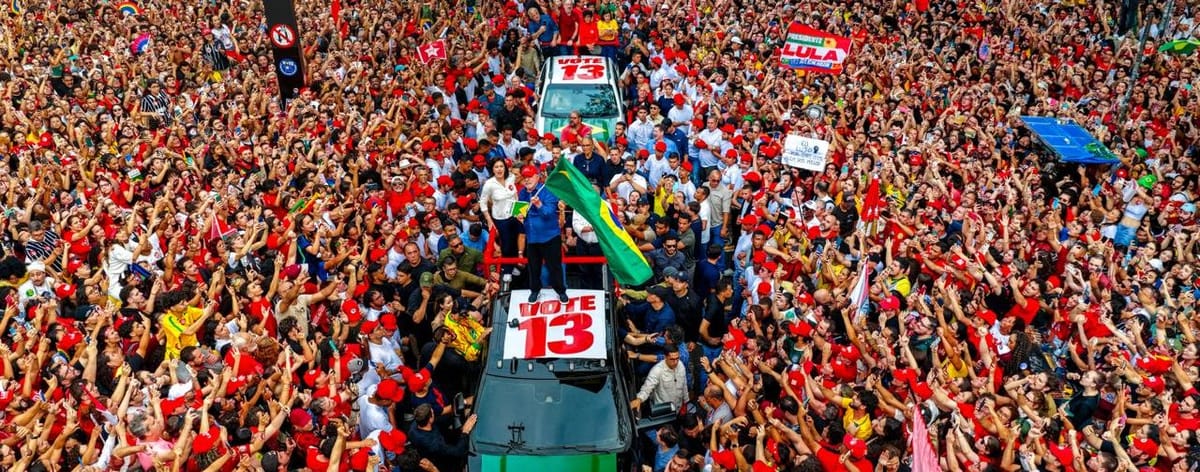
Perhaps the most valuable element to emerge from the Brazilian elections is the organization of young people who took to the streets to make their voices heard. In the interpretation advanced in this essay, coloniality and subservience to projects and interests external to Brazil and South America suffered a defeat. This was not a victory produced by economic capital, but by the force of what allows democracies not to die: the participation of each citizen in the political life around them. Politics and power are not external to the individual; they arise from political agency and extend into the collective, united by solidarity and by the possibility of building a future that has not yet been written. Perhaps this is the lesson of this young democratic experience called Brazil: resistance and solidarity.
Marcial A. G Suarez is professor of Political Science and International Relations at Universidade Federal Fluminense, Rio de Janeiro, Brazil, and visiting researcher at University of London, Goldsmiths.