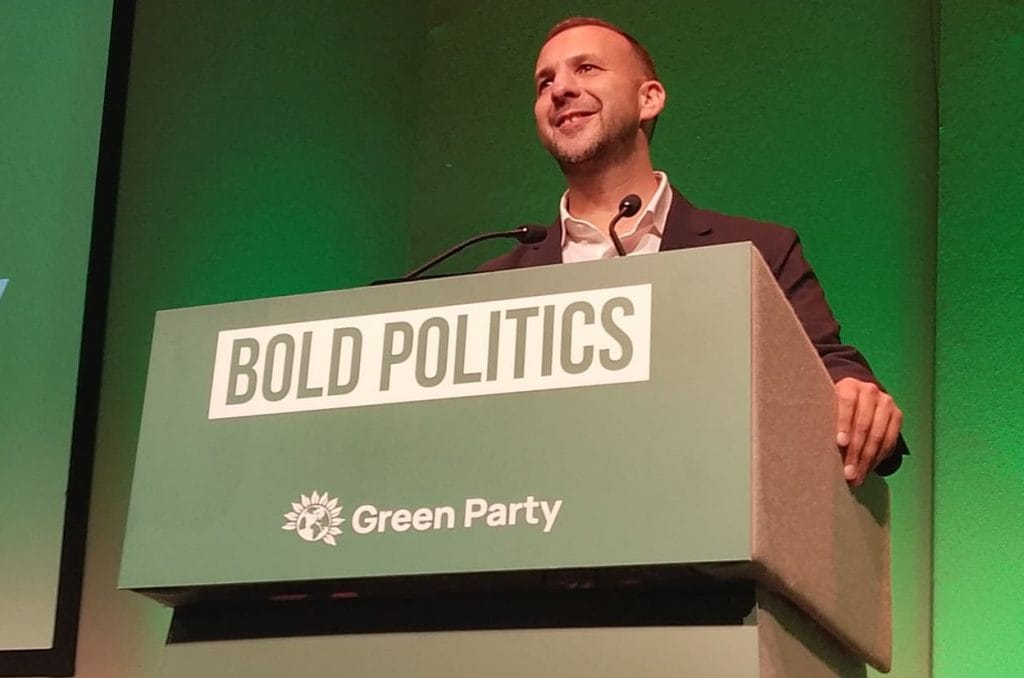
Zack Polanski was elected leader of the Green Party of England and Wales (the Scottish Greens are a separate party) in September 2025. He has already made an impact. In the face of a swiftly rising tide of right-wing populism, it might be argued that he is the ethical Machiavelli, capable perhaps of building the Greens into a force able to challenge and change British politics.
Machiavelli, author of The Prince, essentially a handbook for late Medieval, early Renaissance political leaders, is a symbol of evil. Ever since Shakespeare, he has been condemned as the ethics-free architect of murderous real politics. Hardly a role model or point of comparison for a Green Party leader? However, several authors have suggested new interpretations of Machiavelli, noting a concern with creating a united Italian State, advocating for democratic city-states, and creating the basis of a materialist political science (for example, Lefort 2021). Machiavelli reminds us that politics has a productive dimension, an ability to construct an alternative society rather than just to imagine an ethical picture of a different order. A materialist politics stresses that politics exists in a particular context, and close attention to that context opens the possibility of interventions that lead to change.
The Green Party's context is challenging. A pessimistic yet insightful study titled ‘The Withered Greening of British Politics’ was published in 1986 (Rüdig and Lowe, 1986) remains instructive. While the Party has had some success since the 1980s compared to continental European Green Parties in countries such as Germany, France, and Belgium, Greens in Britain have faced a cold electoral climate. In the 2024 General Election, the organisation managed to elect 4 Members of Parliament, a modest success indeed, given over 50 years of electoral effort since the party was founded in 1973. In Scotland, the Greens have done better, and in England and Wales, the Party has elected over 800 local councillors in recent years. LOCAL ELECTIONS 2025: IT'S A RECORD 859 GREEN COUNCILLORS ON 181 COUNCILS - Thanet Green Party, yet major influence has eluded the party, despite decades of sustained effort.
In turn, Greens in Europe who have been more electorally significant face an increasing threat of marginalisation. The ever more obvious reality of climate change, with increasing episodes of extreme weather, rather than as might be expected, has seemingly driven a strongly anti-environmental wave of right-wing politics. While Trump has been in the headlines for his opposition to renewable energy and hostility to climate action, it is easy to forget that a similar Trumpian politics is winning support across Europe. Richard Seymour (2024) argues that disaster nationalism is an increasingly significant force in international politics, with climate change encouraging the pursuit of national self-interest in an increasingly dangerous world. In France, the far-right National Rally looks likely to win the next Presidential election; in Germany, the Alliance for Deutschland is a stronger contender for power; Vox is a possible kingmaker in Spain, and, of course, in the UK, Nigel Farage’s Reform Party tops the opinion polls. Similar right-wing populist parties hostile to climate action, vigorously opposed to migration, and advocating authoritarian rule are significant in many other European states, from Portugal to the Baltic states.
Zack Polanski has already shown some strategic potential. His successful campaign to become Green Party leader is instructive. To gain nearly 80% of the vote against incumbents who were MPs and endorsed by well-known former leader Caroline Lucas suggests considerable practical political ability. Since being elected, the Party has grown by a remarkable 300% to reach over 180,000 members. Opinion poll ratings have sharply increased, with several showing Polanski’s Party ahead of the governing Labour Party. In turn, councillors have defected in some numbers from Keir Starmer’s Labour Party. So far, Polanski has used both social and traditional media to give the Greens a voice. He has shown a keen awareness of political possibilities, particularly the frustration of left- and centre-voters with Labour.
Interestingly, this has proved to be a hegemonic challenge, seeking to gain control of the narrative from a marginal position. Polanski challenges militarism and austerity. He is a strong supporter of trans rights. Above all, he has challenged the anti-migration politics promoted by Reform and endorsed to a large extent by Labour and the Conservatives.
The ‘disaster nationalism’ of Reform has built on frustrations with both Labour and the former governing Conservative Party, capturing voters disillusioned with British politics, nostalgic for a perhaps misremembered past, and hostile to minorities. Both Labour and the Conservatives have sought desperately to recapture the affections of Reform voters, with anti-migration policies, advocated by ethnic minority politicians who are sometimes the children of migrants. In a clear break from this, Polanski has noted his Jewish heritage to strongly defend the positive value of migration.
Polanski’s defence of migration, along with solidarity with Palestine and sympathy for deeper and durable links with Europe, has provided an attraction for left and centre voters, dismayed by Labour’s move to the right. While passionate about climate action, Polanski is explicit that social and economic policies are essential if the Green Party is to become more electorally significant. Electorally, the challenge to Labour could see the Greens gain 30 or 40 parliamentary seats in the next General Election, even in a ‘first past the post’ system. The Green electoral challenge appears strongest in London, where Polanski is already a member of the Greater London Assembly.
There are significant challenges. Reducing the Labour vote while increasing the Greens' share of the electorate looks like a certainty, but could, consequently, deliver a Reform government, committed to dismantling net zero, along with sharply regressive social policies. Likewise, while the Green Party membership has mushroomed in the past, for example, in 1980, 1989, and 2011, waves of enthusiasm have been short-lived; the Party has repeatedly failed to retain members or create a strong culture of activism amongst the members retained. The minuscule turnout in Party leadership elections, of around 38%, is one symptom of this. Zack Polanski was elected Green Party leader in a landslide victory - Left Foot Forward: Leading the UK's progressive debate. Members historically have joined in large numbers, but only a minority are engaged in party activism, and membership soon falls back. Given the fractured nature of British politics, a popular and charismatic leader could overcome these challenges and even win in a General Election. In the past, this might have seemed impossible, but at present, any party with 30% of the vote looks set to gain a potential parliamentary landslide.
Yet if the Greens gain government power, either outright or as part of a coalition, this will introduce additional challenges. From four MPs to the government is a big leap; Green parliamentarians would lack experience. Even the present Labour government has found the practice of government difficult to manage after a long absence from executive power. In turn, what would the role models for green governance look like? European Greens from Ireland to Germany, Portugal to the Netherlands, have taken part in coalition governments, but their largely centrist and cautious approach seems exhausted. There are, no doubt, numerous challenges to Polanski’s leadership of the Green Party.
Perhaps the point is that all political success is temporary and built on shifting sands. However, with Polanski, a more focused, materialist approach to green politics opens up new possibilities. Given the acceleration of climate change, the failings of a neoliberal economic order, rising political dissatisfaction, and deepening inequality, a green approach capable of intervening strategically is needed. Can Polanski contribute to a more sophisticated, radical, and effective Green Party? Initial evidence is positive but seeing how events unfold and whether his challenge is sustained will be fascinating to observe.
Bibliography
Lefort, C. (2012) Machiavelli in the Making. Northwestern University Press.
Rüdig, W. and Lowe, P. (1986) ' The withered 'greening' of British politics ' , Political Studies, 34: 262-84
Seymour, R. (2024) Disaster Nationalism: The Downfall of Liberal Civilization. Verso
Derek Wall teaches political economy at Goldsmiths, University of London and is a former Principal Speaker and International Coordinator of the Green Party of England and Wales.