A worried Iranian student in the West gets a call from Tehran after five days of nothing. Not a normal call. Not the kind where you say hello twice and laugh at the signal. This one comes with rules built into the line. One way. One operator. Her father can reach her. Her mother cannot. She cannot call back. She cannot even ask, are you safe to talk right now, because the question itself feels unsafe.
So she does what people do under pressure. She pretends it is ordinary.
They speak about tea. The weather. Whether they ate. Small talk becomes an act of care because the real questions, are you hiding, are you being watched, did they arrest anyone nearby, sit in the throat like stones. She listens for what is not said.
She hears anger in him. Not the loud kind. The tired kind. The kind that has lived too long with humiliation and still wakes up every morning to the same walls. He wants to say more. He cannot. He knows the cost of carelessness.
That is what power looks like in the Islamic Republic. Not only arrests and bullets, but control over breath, over routine, over the simple human act of asking: are you alive?
This is the human texture that disappears when analysts here talk about Iran like it is a puzzle.
When we say “communications restrictions”, we mean a daughter who cannot call her mother back. When we say “pressure on civil society”, we mean a father lowering his voice in his own home. When we say “stability”, we mean the stability of a prison that has learned how to sound like normal life.
That is the quiet cruelty of the state. It does not always arrive with sirens. Sometimes it arrives as a phone call that finally comes through, and still does not let you speak freely.
The Quiet Machinery of Control
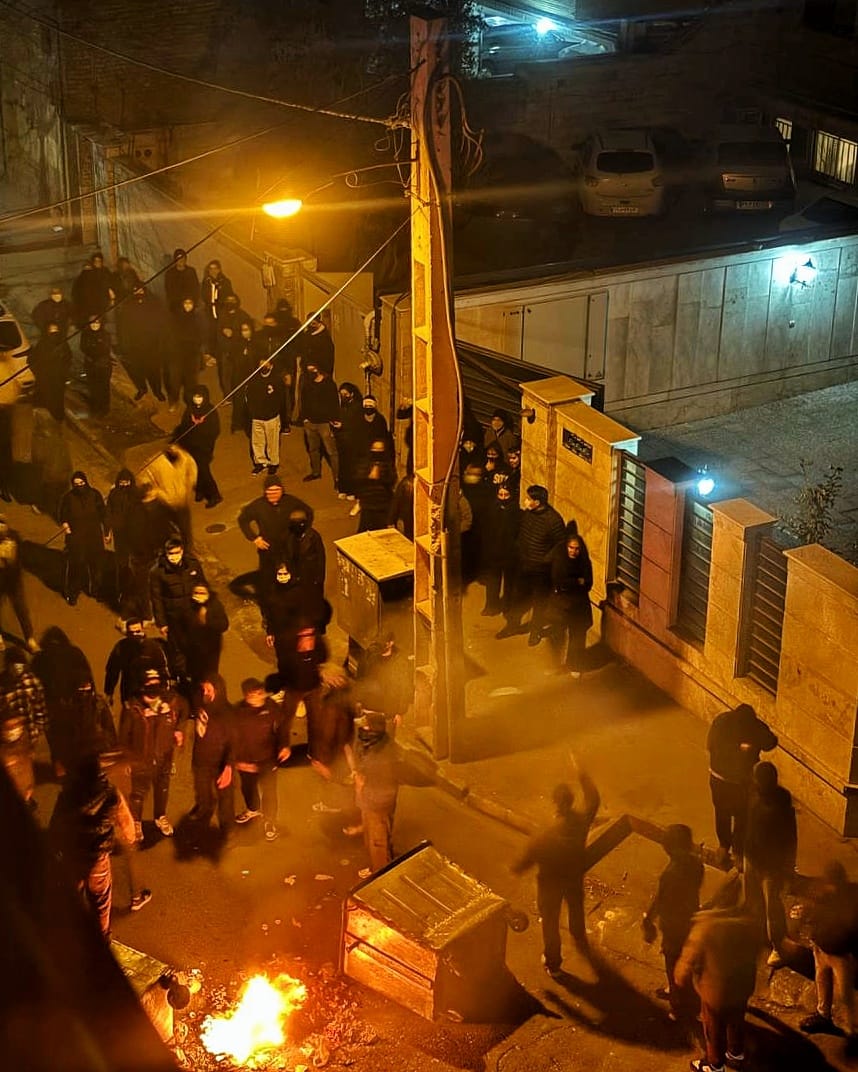
What we are witnessing now is not simply “unrest”. It is a regime trying to seal a pressure vessel that has been overheating for years, while the outside world circles with its own interests. Protests are spreading. The crackdown is widening. Arrests multiply. Lethal force is routine. The blackout remains the regime’s most reliable weapon.
And here is the central failure of the moment: everyone has a plan for Iran, but almost nobody has a plan for Iranians.
The Regime Is Not a Man
Western commentary keeps returning to the fantasy of the switch. Remove the Supreme Leader and the lights come on. But the Islamic Republic is engineered to survive decapitation. It is not one bunker or one face. It is a dense web of security organs, patronage networks, ideological gatekeepers, and beneficiaries trained, paid, promoted, and morally shaped by the state. That last word matters: beneficiaries.
It is comforting to imagine a clean divide between “the people” and “the regime”. The reality is muddier. Over decades, the state has not only terrorised. It has recruited. It has tied livelihoods to obedience. It has made the state feel like family, and dissent feel like betrayal of your cousin, your uncle, your brother-in-law.
When change comes, that is where the blood risk lies. Not in abstract sectarianism, but in neighbourhood arithmetic. Who worked where. Who informed on whom. Who got the contract, the flat, the scholarship, the promotion.
So yes, the regime can be weakened. But the question is always the same: weakened into what?
The Danger of a Cheap Victory
Libya is the warning the region cannot forget. Not because Iranians are Libyans, but because the method is familiar. Break the centre. Shatter the monopoly of force. Let the country “sort itself out”. That method leaves a vacuum filled by armed men and foreign patrons. It produces permanent transition, permanent emergency, permanent mourning.
The outside powers are not seeking justice. They are seeking a cheap victory.
Listen to how Washington and Tel Aviv discuss “options”. It is the language of pressure without price. Precision without responsibility. Maximum leverage, minimum cost. And if cost appears, it should appear on Iranian bodies, not American or Israeli ones.
That is why the most dangerous phrase in circulation is not “regime change”. It is “regime change without boots on the ground”.
It signals a preference for bombing and covert action while refusing the one element that actually determines political outcomes after collapse: protection, enforcement, rebuilding, and a security settlement that prevents revenge from becoming the new order.
This is why escalation remains frozen at the edge. Iran can retaliate. Its capacity is real, even if its governance is rotten. A strike that looks clean in a briefing room can turn filthy within hours if missiles fly, proxies activate, or miscalculation becomes regional fire. So the major powers threaten, posture, retreat. Not because they care about Iranians, but because they fear costs landing at home.
There is also a contradiction at the heart of this moment that deserves attention. For all its internal reach and coercive power, the regime has displayed real vulnerability in its external and operational security. Israel’s ability to strike inside Iran and eliminate a senior Hamas leader on what were effectively IRGC-controlled premises was not merely an intelligence success. It was a political exposure. It demonstrated that the regime’s protective shell is far more porous than its own mythology suggests. During the twelve-day confrontation, both the United States and Israel removed a significant share of high-level personnel, while Iran’s regional proxy structure, including senior Hezbollah leadership, capitulated with striking speed. This is not the behaviour of a system operating from deep strategic confidence.
This suggests something more dangerous than simple weakness: a regime that commands public space but is hollowing out internally. Coordination is faltering, intelligence is compromised, control is thinning. So the strategy becomes obvious: not a dramatic takedown, but a careful, grinding reduction of its power. The weaknesses are visible. The access is real. Yet the fear of what follows a sudden collapse restrains escalation. Degrade the regime’s command systems. Disrupt its missile capacity. Expose its intelligence failures. Let internal pressures do the rest. It is a familiar model. Libya proved that collapsing the centre without managing the aftermath condemns a country to unending crisis.
Trump Is Not a Strategy
Trump is not a strategy. He is a hazard. Many want to treat him as a lever. If he tells Iranians to rise, they will rise. If he threatens tariffs, Tehran will fold. If he offers support, the regime will fall. That is illusion.
Iranians do not need an American strongman to teach them resistance. Protest is not a trend. It is what remains when the future has been stolen so many times that fear stops working.
But Trump matters because he is transactional. He can praise protesters in the morning and cut a deal by nightfall if it flatters him, enriches allies, or serves his own politics. That uncertainty becomes part of the battlefield. It traps Iranians inside a contest where powerful men treat their country as a bargaining chip.
The Opposition’s Missing Architecture
The opposition's problem is not courage. It is architecture. Across the diaspora there is a particular ache. Not only anger, but the absence of structure. No unified leadership with legitimacy inside Iran. No shadow cabinet. No negotiated roadmap capable of preventing chaos.
This is why the Shah’s son keeps returning to the conversation. As a symbol, he offers something dangerously simple: a name. A figure who can say “transition”. For some, that feels better than the void.
But symbols do not run states. The monarchy’s memory is not neutral inside Iran. Nor is proximity to Israel. In a country where nationalism and humiliation have been fused by decades of sanctions and covert war, any opposition figure seen as aligned with foreign power becomes a gift to the regime.
The regime will point and say: see. Puppets. And then it will shoot.
When Youth Rises, Power Responds
Students can ignite a nation. They can also be trapped. Students were central in 1979. They were central after Mahsa Amini. They are central again because youth is where fear breaks first.
But the state has adapted. It has infiltrated campuses, built loyalist student groups, normalised security inside academic life, turned education into surveillance, and scholarships into discipline. A student surge is possible. Sustaining it under blackout, mass arrest, and collective punishment is the harder task.
That is why the Bangladesh student uprising is such a seductive comparison, and such a false one. There, popular mobilisation flooded the system and split the state’s coercive machinery. In Iran, security structures are fused to regime survival. The threshold for rupture is higher. The cost is heavier.
Faith, Power, and Moral Collapse
The moral language has also been stolen by the Islamic Revolutionary Guard Corps (IRGC) men without mercy. One sentence from Iranians carries unbearable clarity: these people are not Muslim. Not as insult. As moral verdict. The regime has wrapped cruelty in religious legitimacy for so long that it has hollowed the meaning of piety. Officials pray loudly and torture quietly. They speak of God while treating human beings as disposable. Western media then completes the distortion by accepting the regime’s self-description at face value, as if brutality were faith, as if repression were Islam, as if the prison were a mosque.
It is not.
Any tradition, religious or secular, that demands nothing of you toward other human beings is not morality at all. It is an empty language of self-regard. It is a system of gestures that point upward while turning away from the people standing in front of you.
And no, the United Nations will not save Iran
The UN reflects power. It does not replace it. When major powers are divided or cynical, the UN becomes a theatre of statements, not enforcement. This is not abstract; it is the lived experience of multiple crises where appeals to international law repeatedly meet the immovable interests of great powers. Across Gaza, Ukraine, and Venezuela, the UN’s ability to turn moral language into effective protection has been limited at best and paralysed at worst because its enforcement mechanisms are shaped by those same powers whose interests often conflict with humanitarian needs.
What a Humane Transition Would Require
What this moment requires is not only the end of the Islamic Republic. It requires a transition built around Iranian lives. Because if the regime falls, the hardest work begins the next morning. Prisons open. Scores are settled. Armed factions test the streets. Foreign powers compete for influence. Opportunists rename themselves saviours.
A humane politics starts with a blunt premise: the goal is not only to destroy the regime. It is to prevent Iran from becoming another landscape where the weak pay for the fantasies of the strong.
That demands a transition architecture grounded in reality:
- protection against revenge spirals
- security arrangements that dismantle coercion without dissolving the state
- a credible path to elections
- communication systems the regime cannot strangle with a switch
- international pressure focused on civilian protection, not prestige
None of this is romantic. It is the necessary labour of stopping a revolution from being devoured by its aftermath.
Iran is not a chessboard
It is not a problem to be solved or a position to be exploited. It is a society under strain, held together by people trying to live ordinary lives in extraordinary conditions. Parents who lower their voices on the phone. Daughters who measure time by absence. Students who learn, too early, the cost of being seen.
Destroying a regime is mechanically simple. Protecting a society is the real test of political maturity.
If outside powers truly claim to stand with the Iranian people, they should begin by treating Iranian lives as something other than expendable.
Because at this moment, too many powerful men are looking at Iran and seeing opportunity, while Iranians are looking at Iran and trying to survive.