There were six of us. Academic colleagues, though the word felt a bit too neat for the kind of evening it became. We went to Dundee Contemporary Arts (DCA). A place I have always thought of as open, almost generous in its spirit. It has been part of the city since the late 1990s. Not just a gallery or a cinema, but a space where things gather. Film, art, conversation.
We were there to watch Everybody To Kenmure Street.
I almost did not go.
I know what certain images do to me. I do not pass through them. They stay. A moment of unkindness does not pass cleanly for me. It returns later, without warning. It asks to be felt again. That is not always easy to carry.
Just before the lights dimmed, one of my colleagues, a very dear and kind friend, leaned in and said gently, this one is uplifting. I held onto that.
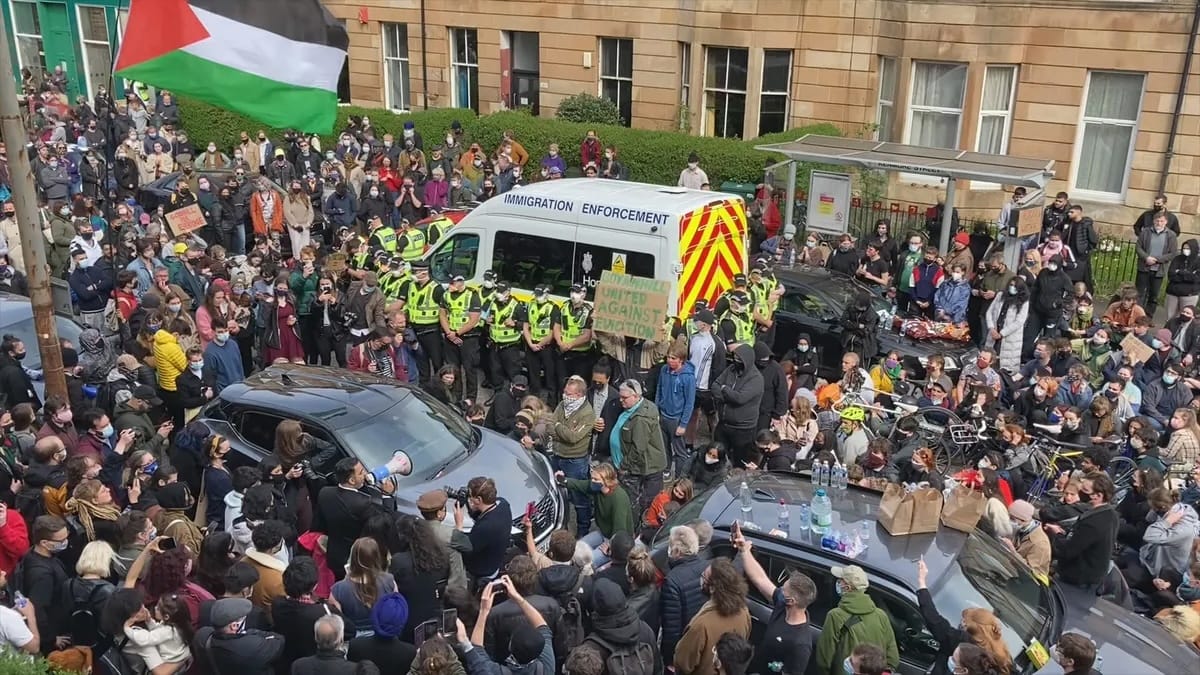
The documentary film begins softly. A street. A vehicle. The normal operation of authority moving through a typical location. The scene feels familiar. Authority presents itself as routine. As procedure. Nothing unusual occurs or needs to be evaluated.
Then something shifts, quietly at first. A few individuals stand up. They do not chant or declare anything. They simply refuse to leave.
At first glance, it appears uncertain. As if even those standing are still deciding what this moment is. Then other people begin arriving. Unsummoned. Without organised instruction. People came because something seemed wrong. That’s all. Yet, it was sufficient.
More people gather.
The number of people grows. The street thickens. However, it happens peacefully. With no apparent plan or agenda. Only bodies - present and staying.
Time moves slowly. All movement ceases. What was initially supposed to flow through is now halted. A hush settles, not empty, not neutral. Within it, something begins to shift.
We often treat power as fixed in direction, flowing from the top down. Decisions made elsewhere settle into the lives of those who must adapt. It becomes a habit of thought. Almost a discipline to simply accept that model as natural.
However, for just a brief moment, that model falters. Not destroyed. Not reversed. Simply interrupted. Authority hesitates.
Not because it has reconsidered its decision-making process, nor because it recognises a moral element to the action taking place before it. Rather, authority encounters something that it finds difficult to process: collective refusal that does not disintegrate.
There is no script for this. Only presence. People continuing to occupy their spot while everyone else expects them to vacate that area.
It seems simple enough. It isn’t.
Staying requires something hard to articulate. Time, certainly. But also an unofficial determination to stay when there is no guarantee that your actions will produce results. And still, they stay.
That is where the film sits with you. It pushes against a familiar habit. The habit of watching, reacting briefly, then returning to life as it was. The habit of recognising injustice without interrupting it.
Kenmure Street disrupts the rhythm. Continuation is not assured. Power depends on ease. Compliance. Absence. When absence breaks, even briefly, strain appears.
Something softer follows. A glimpse of a pattern undone.
Then, gradually, the film starts to draw inward toward itself.
At some point I began to think about our universities - about the recent job cuts. About how decisions seem to come pre-determined. Emails: polite but consequential. Meetings which serve merely to affirm or ratify; meetings which leave no room for doubt regarding outcomes and their necessity.
People adapt. Offices are vacant. Conversations cease abruptly.
There is no street upon which one could assemble; no van to obstruct the flow of traffic. In universities, power functions differently than it does in the streets of Glasgow. It operates through language; through institutional structures; through a measured repetition that says “this is how things have to be.”
Most of the time, it succeeds.
Quietly, communities absorb it. Quietly departments disappear. Quietly something collectively diminishes in size and scope. Not quickly. Nor suddenly. Almost imperceptibly. Which makes confronting it even more difficult.
Only later do you see what has gone. What isn’t there anymore.
The question stays open.
What would interruption look like in your university?
Not abstractly; not in terms of a rhetoric of resistance that flows seamlessly from context to context. But within the real spaces you occupy daily; within the institution that represents itself as having no place for confrontation – though it shapes lives just as surely as the physical streets of Glasgow do.
This is a difficult question. Power here operates in ways that are less visible; more dispersed; less identifiable; less accessible.
And yet, some residue of Kenmure Street lingers.
The idea that continued existence is not neutral. The notion that consent need not necessarily follow automatically after decision-making processes have taken their course. The understanding that the gap between what was decided and what lives have been shaped by those decisions is not always static. It can shrink. Not through certainty. Not through guarantees. Through presence. Through individuals who decide at a particular moment to stand in the way instead of stepping aside.
Perhaps this is also where the film ends. Not with a message of hope in any direct sense.
Nor with an implicit promise that change will occur if enough people gather together. With something different and simpler and more insistent.
The knowledge that interruptions are possible.
And the question of whether we are prepared, in our own work lives, in our own institutions, to identify the moments when standing may matter.
Dr. Abdullah Yusuf is a Senior Lecturer (Associate Professor) in Politics and International Relations at the University of Dundee, UK. He studied Public Policy and Diplomacy at The Australian National University in Canberra, Australia, and holds a PhD in International Relations from the University of Dundee. His research and scholarship interests include: International organizations (United Nations, League of Arab States, and African Union); Politics of the Middle East, including Palestine, Israel, and the Arab-Israeli conflict; Politics of humanitarian armed interventions; Peacekeeping and post-conflict peacebuilding; International law and refugee protection; Climate politics; Post-colonial Studies. For more details on my teaching, research, and scholarship profile, please visit: his research profile and bio.